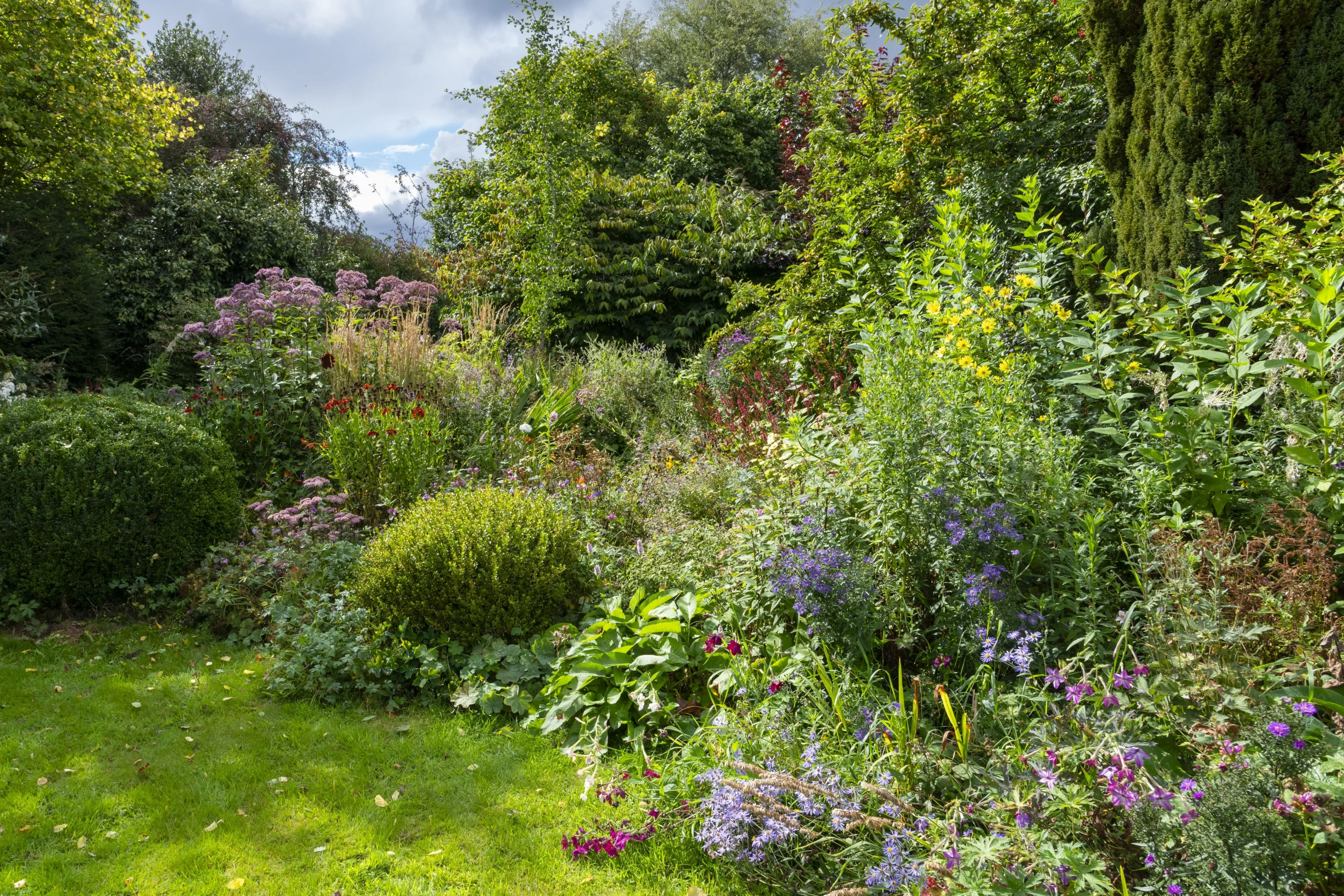
We all start to feel the heat at the end of summer, plants included. When your garden looks weary after weeks of humidity and high temperatures, an easy solution is to add some autumn all-stars to the mix. The following perennnials, shrubs, and ornamental grasses offer colorful foliage, flowers, and seedheads that light up the landscape as the weather cools down.
Birchleaf Spirea
The white spring flowers and clean green foliage of birchleaf spirea (Spiraea betulifolia) are reason enough to grow it, but the mounded shrub’s fall color is its most outstanding quality. The small oval leaves turn brilliant shades of red, orange, and purple in early fall. Pair birchleaf spirea with low-growing evergreens such as junipers or false cypress.
Growing Conditions: Full sun to part shade and well-drained soil
Size: 3-4 feet tall and wide
Zones: 4–8
Dwarf Fothergilla
Native to the southeastern United States, dwarf fothergilla (Fothergilla gardenii) has clear yellow, orange, and reddish foliage in fall. Its honey-scented flowers in spring are an early-season delight for both pollinators and people. Though this shrub will grow well in shade, the brightest fall color develops with at least 6 hours of direct sunlight per day.
Growing Conditions: Full sun to part shade and moist, loamy, well-drained soil
Size: 3-5 feet tall and wide
Zones: 5–8
American Cranberry Bush
The name says it all—American cranberry bush (Viburnum opulus var. americanum) has bold cranberry-red foliage and berries in fall. Plant several cranberry bushes together to form an upright, rounded hedge. Its arching stems give it a casual appearance. Its white spring flowers are followed by red fruit in late summer that attracts birds.
Growing Conditions: Full sun to part shade and moist soil (tolerates poor drainage)
Size: 5-8 feet tall and wide
Zones: 2–7
Fragrant Sumac
A woody native shrub, fragrant sumac (Rhus aromatica) has glossy green leaves until they turn a mix of red, yellow, burgundy, and purple in autumn. This tough, low-maintenance woody plant is excellent for naturalizing on slopes or other areas you can allow to get a little wild. For a tamer version, look for ‘Gro-Low’, which grows up to 2 feet tall and up to 6 feet wide.
Growing Conditions: Full sun to part shade and a range of soil (tolerates sandy and clay soils)
Size: 6-12 feet tall and 4-6 wide
Zones: 3–9
Oakleaf Hydrangea
A North American native, oakleaf hydrangea (Hydrangea quercifolia) has foliage that resembles oak tree leaves and large, cone-shaped flowers. Those leaves steal the show in fall, when they turn shades of burgundy. Oakleaf hydrangea has a mounded shape and slowly forms a colony. It grows 3 to 5 feet tall and wide and mixes well into a shrub border. Use it as a focal point in a perennial bed.
Growing Conditions: Full sun to part shade and moist, well-drained soil
Size: 3-5 feet tall and wide
Zones: 5–9
Goldenrod
Easy-care goldenrod (Solidago spp.) lights up the fall garden with plumes of bright yellow flowers. Along with providing valuable nectar to bees and butterflies late in the growing season, this native perennial is also the host plant for more than 130 species of butterflies and moths.
Growing Conditions: Full sun and average soil (tolerates poor soil)
Size: 2-4 feet tall and 2-3 feet wide
Zones: 3–9
Joe Pye Weed
Native to North America, Joe Pye weed (Eutrochium spp.) produces clusters of fragrant, pink-purple flowers from midsummer until the first frost. Use these medium to large, upright perennials to anchor the back of a landscape bed where they can slowly spread.
Growing Conditions: Full sun and consistently moist soil
Size: 4-7 feet tall and 3-4 feet wide (depending on species)
Zones: 4–8
Turtlehead
Turtlehead (Chelone spp.) gets its name from the two-part flowers that resemble open-mouthed turtles. The white, pink, or red flowers bloom from late summer into fall. Native to swampy areas, these perennials thrive in rain gardens or along water features, though they will tolerate all types of soil conditions once established.
Growing Conditions: Full sun to part shade and consistently moist to wet soil
Size: up to 4 feet tall and 2 feet wide
Zones: 3–9
Little Bluestem
The foliage of little bluestem (Schizachyrium scoparium) is a kaleidoscope of color from spring through fall. The striking blue-green spring and summer foliage turns warm shades of copper, orange, and maroon in fall. Delicate white flower heads dance above the clump of leaves in early fall. Choose a cultivar, such as ‘Blaze’ or ‘Carousel’, for a compact, upright plant.
Growing Conditions: Full sun and average soil
Size: 3 feet tall and 2 feet wide
Zones: 3–9
Prairie Dropseed
The fine, arching leaves of prairie dropseed (Sporobolus heterolepis) turn golden bronze with orange or copper highlights in fall. Open, airy seed heads rise above the fountain of foliage, providing food for songbirds and other animals. Plant it on a slope as a tall groundcover that provides low-maintenance erosion control.
Growing Conditions: Full sun and average to dry soil
Size: 2-3 feet tall and wide
Zones: 3–9
There’s no need to wait until spring to plant these autumn favorites. Moderate temperatures and more regular rainfall make early fall an ideal planting time. Aim to plant new perennials, shrubs, and grasses at least six weeks before the first frost.
- <span>Gardening</span>
- <span>Trees, Shrubs & Vines</span>
- <span>Shrubs</span>